Services
This section describes the high-level structure of CHIA and how different layers of services and supprting building blocks interact to enable cross-border healthcare interoperability.
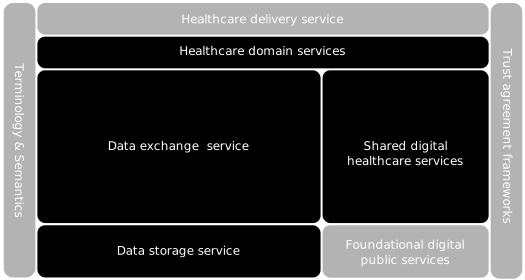
CHIA distinguishes between different categories of services that together enable interoperable healthcare across borders. These services are defined as follows:
- National healthcare delivery services: The actual provision of care to patients by healthcare professionals and organisations
- Cross-border healthcare services: Core healthcare-specific capabilities, such as clinical workflows, patient management, and care coordination
- Data exchange services: Mechanisms that enable the secure and standardized exchange of data between systems
- Data storage service: Inherently distributed sources of healthcare data and can be used a source for delivery
- Shared digital healthcare services: Reusable services that support multiple healthcare applications (e.g. patient identity, consent, registries)
- Foundational digital public services: Cross-sector services such as digital identity, financial transaction, energy management, transportation, and other infrastructure used across domains
- Trust frameworks: Legal, organizational, and governance agreements that enable trusted cross-border collaboration
- Terminology & semantics services: Standards and services that ensure consistent meaning and interpretation of health data
These service categories of services are consistent with the WHO's Digital Public Services, the WHO's Digital Public Services for Health, and Sigra's Reference Architecture.
Scope and positioning
Not all service categories are defined in detail within CHIA.
National delivery services are not described in detail in the architecture. Instead, the architecture is designed to support and enable effective healthcare delivery, which is reflected in the guiding principles.
Terminology and semantics services are used as input for defining standards within the building blocks. CHIA aims to align with internationally recognized standards wherever possible.
Trust agreement frameworks are not specified within the reference architecture itself. They are treated as a prerequisite and constraint, shaping how cross-border interoperability can be realized.
Similarly, foundational digital public services are not defined in detail within CHIA. Their availability and maturity vary across countries and are considered an important constraint for the realization of interoperable solutions.
Cross-border healthcare services
Capabilities
What the service enables (functional behavior).
Consumers
Who uses the service (systems, organizations, or people).
Provider
Which building block or system provides the service.
Inputs / Outputs
What data goes in and what comes out.
Dependencies
Which foundational services are required (e.g. identity, consent).
Constraints
Relevant legal, organizational, or technical constraints.
Data exchange services
Capabilities
What the service enables (functional behavior).
Consumers
Who uses the service (systems, organizations, or people).
Provider
Which building block or system provides the service.
Inputs / Outputs
What data goes in and what comes out.
Dependencies
Which foundational services are required (e.g. identity, consent).
Constraints
Relevant legal, organizational, or technical constraints.
Data storage services
Capabilities
What the service enables (functional behavior).
Consumers
Who uses the service (systems, organizations, or people).
Provider
Which building block or system provides the service.
Inputs / Outputs
What data goes in and what comes out.
Dependencies
Which foundational services are required (e.g. identity, consent).
Constraints
Relevant legal, organizational, or technical constraints.
Shared digital healthcare services
Capabilities
What the service enables (functional behavior).
Consumers
Who uses the service (systems, organizations, or people).
Provider
Which building block or system provides the service.
Inputs / Outputs
What data goes in and what comes out.
Dependencies
Which foundational services are required (e.g. identity, consent).
Constraints
Relevant legal, organizational, or technical constraints.